Research · Editor’s Pick

6 November 2026 · Morogoro, Tanzania · 4 min read
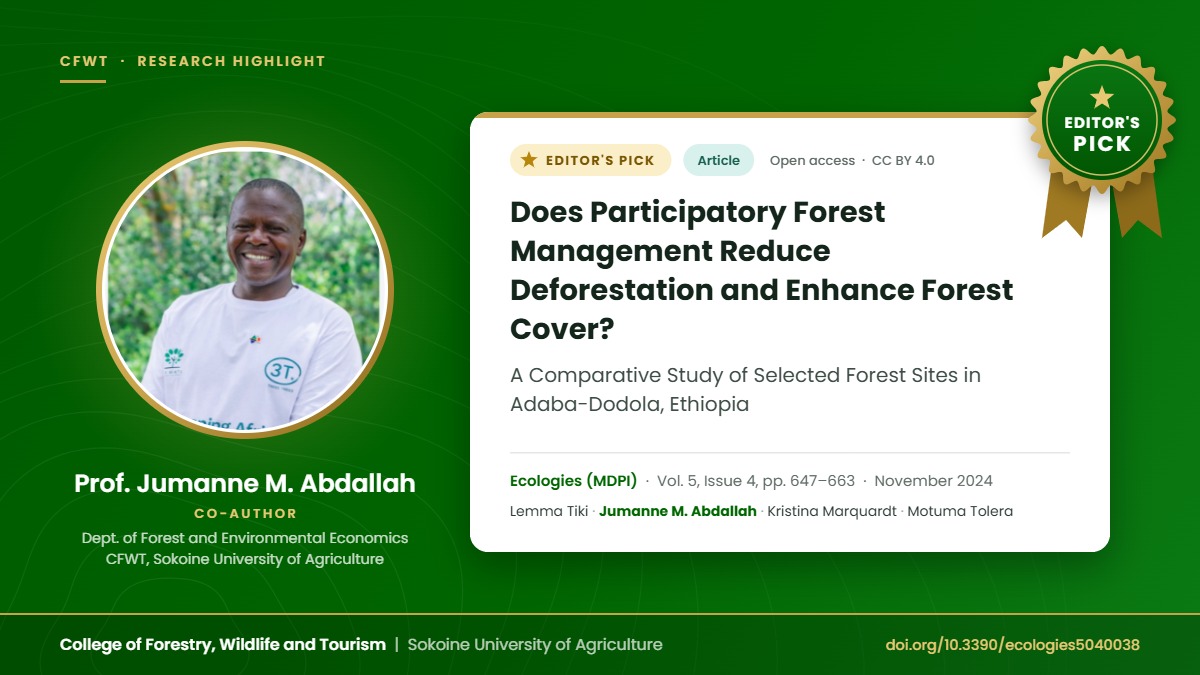
A research article co-authored by Prof. Jumanne M. Abdallah of the College of Forestry, Wildlife and Tourism (CFWT) at Sokoine University of Agriculture (SUA) has been featured as an Editor’s Pick by the journal Ecologies. The study asks whether Participatory Forest Management (PFM) reduces deforestation and increases forest cover, using more than two decades of satellite imagery from the Adaba–Dodola forest in Ethiopia.
Highlighted by the journal’s editors
Ecologies is an open-access journal published by MDPI. Through its official profile on ResearchGate, the journal’s editorial team publishes Editor Picks, short posts that each spotlight up to three articles from the journal for a week. Being selected brings the Adaba–Dodola study to the attention of the journal’s followers and of researchers working on forest governance, land use and conservation.
What the study asked
Ethiopia introduced PFM in the 1990s, handing forest management responsibilities and user rights to communities living next to forests. The Adaba–Dodola forest, on the northern slopes of the Bale Eco-region in the south-eastern highlands, had shrunk from about 140,000 ha in the early 1980s to about 53,000 ha by 1997. PFM began there at the end of the 1990s, when local forest dwellers were organised into a recognised association known as WAJIB.
The research team compared forest sites managed by communities under PFM with sites managed by state enterprises without PFM. They analysed Landsat satellite images from 2000, 2012 and 2023 to map land use and land cover change, and drew on interviews with key informants and focus group discussions in four villages.
What they found
Between 2000 and 2023, forest land increased by 5.89% at the PFM sites and decreased by 5.22% at the non-PFM sites. Agricultural land told the same story in reverse: it fell by 1.65% where communities managed the forest and grew by 9.64% at the state-managed sites. The authors conclude that PFM has been effective in halting deforestation and increasing forest cover in Adaba–Dodola.
Key highlights
- Forest land grew by 5.89% at PFM sites and shrank by 5.22% at non-PFM sites between 2000 and 2023
- Agricultural land fell by 1.65% at PFM sites but expanded by 9.64% at non-PFM sites
- Based on Landsat imagery from 2000, 2012 and 2023, with interviews and focus groups in four villages
- The authors recommend linking REDD+ incentives to community-managed forests
Why it matters
The authors see PFM as a promising route for REDD+ in Ethiopia and recommend devolving forest management to community-based cooperatives, with REDD+ incentives linked to community forests and livelihood support for vulnerable households to reduce illegal forest use. They also note that results depend on legal frameworks, law enforcement and socio-economic conditions, and call for further research on governance, leakage, biodiversity and livelihoods. These questions are equally relevant in Tanzania, where community-based forest management is a central part of forest policy.

Meet the co-author
Prof. Jumanne M. Abdallah
Professor, Department of Forest and Environmental Economics, CFWT
Prof. Abdallah’s research covers forest economics, productive efficiency and natural resource governance and conflicts. On this study he worked with colleagues from SUA, the Swedish University of Agricultural Sciences and Ethiopia.
The research team
The article was led by Lemma Tiki of the Regional Research School in Forest Science (REFOREST) at SUA, CFWT and Ambo University, Ethiopia, with Prof. Jumanne M. Abdallah (CFWT, SUA), Kristina Marquardt (Department of Urban and Rural Development, Swedish University of Agricultural Sciences) and Motuma Tolera (Ethiopian Forestry Development). The research was funded by the Swedish International Development Cooperation Agency (Sida).
Read the article (open access)
Tiki, L., Abdallah, J. M., Marquardt, K., & Tolera, M. (2024). Does Participatory Forest Management Reduce Deforestation and Enhance Forest Cover? A Comparative Study of Selected Forest Sites in Adaba-Dodola, Ethiopia. Ecologies, 5(4), 647–663. https://doi.org/10.3390/ecologies5040038
Contributing to the UN Sustainable Development Goals
Congratulations
CFWT congratulates Prof. Jumanne M. Abdallah, Lemma Tiki, Kristina Marquardt and Motuma Tolera on this recognition, and thanks the editors of Ecologies for highlighting research that informs how forests can be managed with, and by, the communities who depend on them.
Follow us on Instagram
Stay connected with our departments