Training · Syntropic Agroforestry

10 November 2026 · Morogoro and Arusha, Tanzania · 3 min read
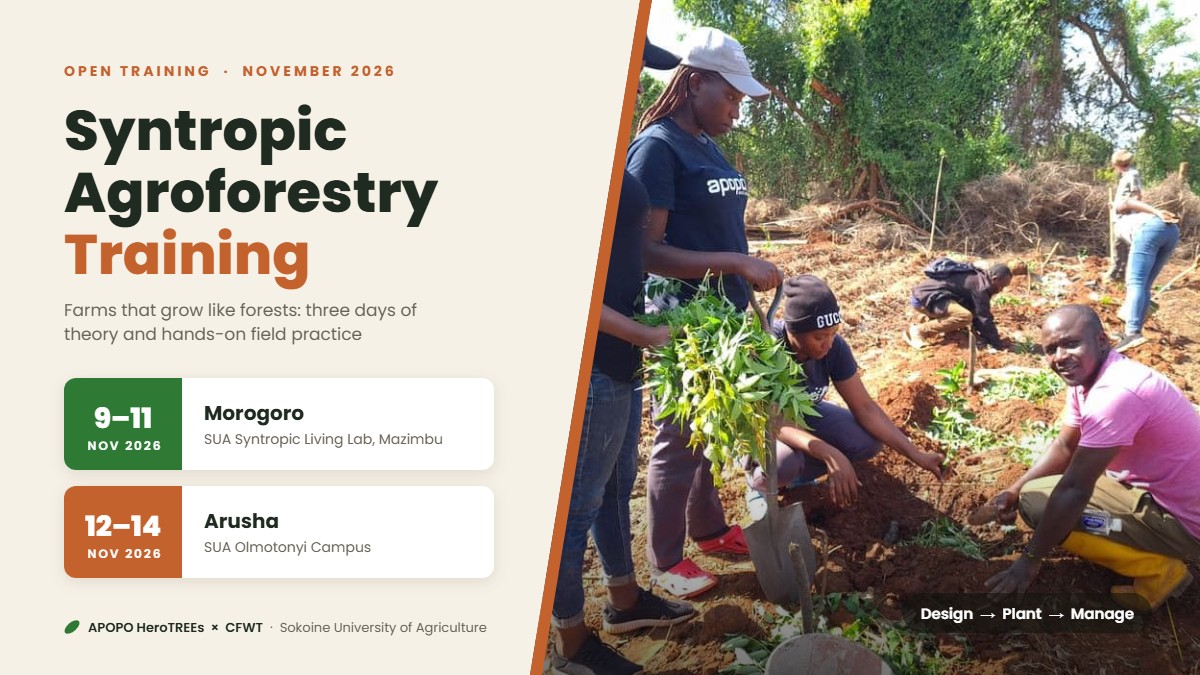
APOPO is running two practical, three-day syntropic agroforestry training sessions this month, in Morogoro from 9 to 11 November and in Arusha from 12 to 14 November 2026. The training is part of the HEROTREES agreement that the College of Forestry, Wildlife and Tourism (CFWT) at Sokoine University of Agriculture (SUA) is implementing with APOPO, and anyone interested is encouraged to register.
What the training covers
Syntropic agroforestry combines food production with ecosystem restoration. It uses plant diversity, natural succession and active management to build farms that produce food and income while improving soil health and supporting biodiversity.
Each session opens with a day of theory, followed by two days of field practice that take participants from farm design to planting and long-term management. Topics include how plants support each other across vegetation layers, choosing and spacing complementary species, strategic pruning, mulching and continuous soil cover, and managing the system as the trees mature. Both sessions are open to farmers, students, agricultural professionals and organisations.
Morogoro: 9–11 November 2026
The Morogoro session is led by Hannes Thaler, CEO of Forests4Farming, who brings more than 20 years of agroforestry and farming experience from South America and Africa and draws on the principles developed by Ernst Götsch, the founder of syntropic agriculture. The training focuses on cashew and citrus combined with annual crops and plants that help regenerate the soil, and is hosted in partnership with My Birthday Tree Organisation (MBTO).
Morogoro at a glance
- Monday 9 November, 09:00–17:00: theory at the SUA National Carbon Monitoring Centre (NCMC)
- Tuesday–Wednesday 10–11 November, 08:00–16:00: field training at the SUA Syntropic Living Lab, Lugala Farm, Mazimbu Campus
- Fee: TZS 100,000; students TZS 15,000 (food and drinking water included)
- Details and registration: APOPO Morogoro training page
Arusha: 12–14 November 2026
The Arusha session is led by Thiong’o Gachie, a Kenyan regenerative agriculture specialist who has trained farmers in Kenya, Uganda, Tanzania, Somalia, Namibia and Eswatini, together with Haji Khamis, APOPO’s syntropic agroforestry trainer. Participants will work with avocado, cashew and macadamia trees grown alongside vegetables and other crops that provide harvests while the trees develop, and will also discuss coffee, bananas and locally suitable support plants.
Arusha at a glance
- Thursday 12 November, 09:00–17:00: theory
- Friday–Saturday 13–14 November, 08:00–16:00: field training
- Venue: SUA Olmotonyi Campus, Arusha (all sessions)
- Fee: TZS 100,000 (food and drinking water included)
- Accommodation: may be available on campus; contact John Mkuya on +255 744 059672
- Details and registration: APOPO Arusha training page
How to register
Registration and payment details are on the APOPO page for each session. Participants should bring comfortable field clothes, suitable footwear and working gear. For Morogoro, further location and transport details will be shared with registered participants.
Register for the training
Morogoro, 9–11 November: APOPO Morogoro training page
Arusha, 12–14 November: APOPO Arusha training page
Questions: Haji Khamis, haji.khamis@apopo.org
Why it matters
The training is organised by APOPO HeroTREEs through its Syntropic Agroforestry Innovation Accelerator (SAIA), which connects farmers, universities, NGOs and agricultural professionals through training, demonstration farms, research and knowledge sharing. Under HEROTREES, SUA campuses are becoming places to learn and test these methods. The SUA Syntropic Living Lab in Morogoro, developed jointly by APOPO and SUA, supports demonstration, practical learning and long-term research, and students have used it to learn how syntropic systems work. Five SUA students have also studied soils and cover crops at APOPO’s demonstration sites in Tanzania.
Contributing to the UN Sustainable Development Goals
Acknowledgements
CFWT thanks APOPO HeroTREEs, My Birthday Tree Organisation (MBTO) and the trainers for making these sessions possible, and encourages students, staff and partners interested in syntropic agroforestry to take part.
Follow us on Instagram
Stay connected with our departments