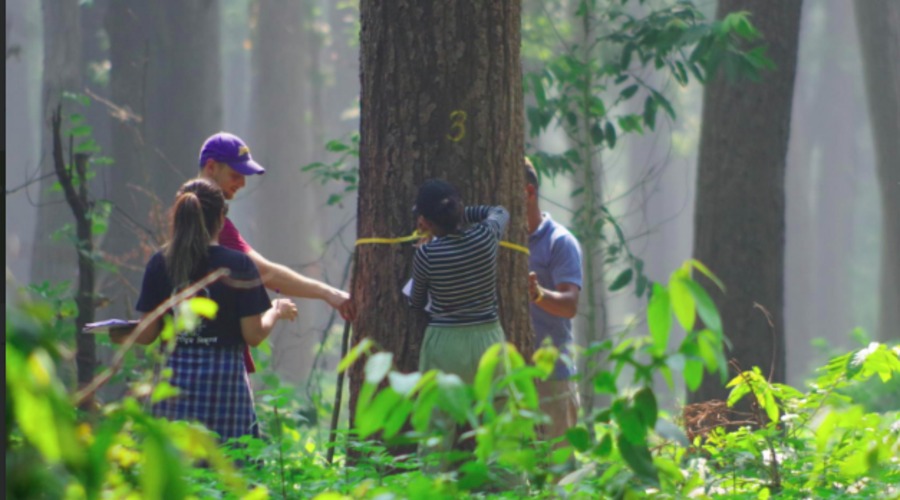
On 16 June 2025, a group of students (Group 6) presented what they had learnt from studying the APOPO syntropic agroforestry plot at Sokoine University of Agriculture (SUA) in Morogoro. Their work took them into a field where trees, shrubs, ground cover and food crops all grow together, and where the goal is to bring degraded land back to life while still producing food and income.
The plot follows the ideas of Ernst Götsch, who believed that a farm can copy the way a natural forest grows and renews itself. Seeing that idea on the ground made it much easier to understand. APOPO uses the system to restore land, improve the soil, increase biodiversity and support local livelihoods, and the students set out to see how well the plot is doing that.
One of the first things they noticed was how the trees take turns. Fast-growing pioneers such as Gliricidia sepium and Leucaena leucocephala come up first, giving shade, feeding the soil and adding organic matter. Under their cover, avocado and coffee grow in partial shade. Later, trees like Cedrela odorata and macadamia take over as the long-term canopy, with timber and nuts to offer in the years ahead. Cocoa is there as a long-term cash crop. Closer to the ground, pineapple covers the soil and brings in early income, beans fix nitrogen, and cardamom adds a spice crop that also helps keep pests away.
The plot also showed them that not everything works as planned. Maize and papaya were doing poorly because of too much shade, and the fast-growing Cedrela was starting to take over. The students saw plenty of bees and other pollinators moving through the plot, yet there were no beehives to make use of them. Animals and fish ponds, which are part of the full syntropic approach, have not yet been added.
From what they saw, the group made some practical recommendations. They suggested keeping macadamia, mango, avocado, cocoa and coffee, keeping a close eye on Leucaena, Albizia and Tithonia, and removing papaya, which has not adapted well. They also proposed starting beekeeping on the plot and, in future, bringing in livestock and fish ponds.
For the students, the exercise was a chance to look closely at a land restoration system in action, see what is working and what is not, and think about how it could be made better.